

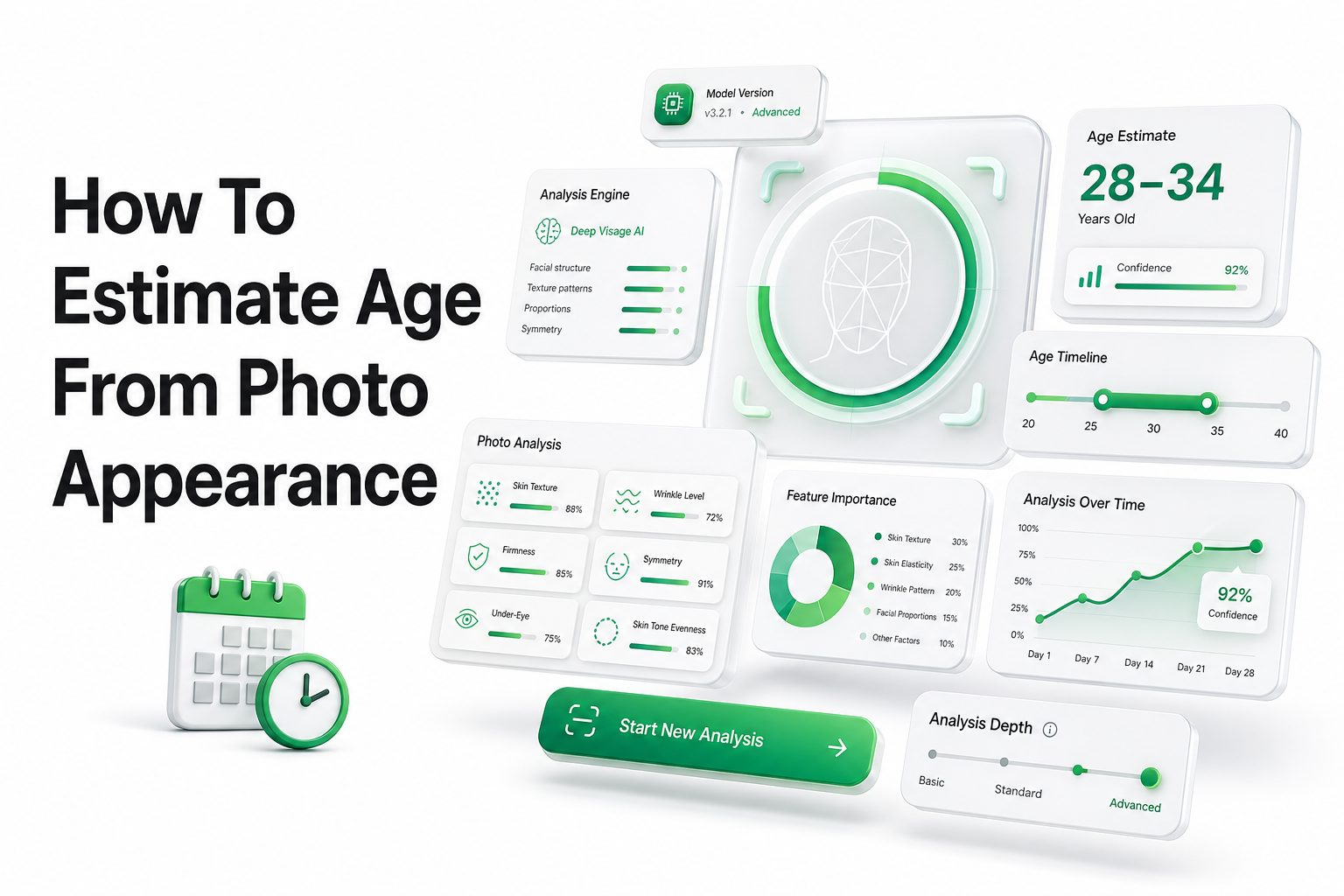
Estimating someone’s age from a photo can feel simple at first glance, but accurate judgment depends on far more than a quick look at the face. Lighting, image quality, styling, facial expression, posture, and even cultural context can change how old a person appears in an image.
Learning how to estimate age from photo appearance is useful in many situations, from organizing old family pictures to improving visual analysis skills for research, design, moderation, or identity-related workflows. Still, it should always be handled carefully, because appearance is not the same as a confirmed age.
This article explains the main visual clues people use to estimate age, the limits of photo-based judgment, and practical ways to make more careful assessments. The goal is not to guess perfectly, but to evaluate visible signs with more accuracy, fairness, and respect.
Why Age Estimation From Photos Is Difficult
Age is not always visible in a predictable way. Two people who are the same age can look very different because of genetics, health, lifestyle, skincare, stress, sleep, and environment. A photo captures only one moment, not the full story of a person’s life.
Cameras also distort appearance. A wide-angle lens can enlarge facial features, harsh light can deepen shadows, and filters can smooth texture. Even a small change in angle may make someone look younger or older than they would in person.
The Main Visual Clues That Influence Perceived Age
Facial structure often gives the first impression. Children usually have rounder faces, softer jawlines, larger-looking eyes, and fuller cheeks. Adults tend to show more defined bone structure, while older adults may have changes in skin firmness and facial volume.
Skin texture is another common clue, but it should not be overused. Fine lines, pores, sun spots, and elasticity may suggest age range, yet makeup, lighting, retouching, and camera resolution can hide or exaggerate these details.
Key Factors That Affect Photo-Based Age Estimates
- Image sharpness and resolution
- Lighting direction and shadow intensity
- Camera angle and lens distortion
- Facial expression and pose
- Makeup, grooming, and hairstyle
- Clothing style and accessories
- Photo filters or editing
- Cultural and personal presentation choices
Facial Features That Commonly Change With Age
In younger faces, soft contours and fuller cheeks often stand out. The eyes may appear large relative to the face, and the lower face may be less angular. These traits are most common in children and teens, though some adults naturally retain them.
As people move through adulthood, facial features often become more defined. The jawline, cheekbones, and nose may appear more prominent, while facial fullness may shift. These patterns can help estimate a broad age range, but they rarely support an exact number.
Skin Texture, Lines, and Surface Detail
Skin texture can provide helpful clues when the photo is clear and natural. Fine lines around the eyes, forehead, and mouth often become more visible with age. Changes in tone, firmness, and sun exposure can also affect perceived age.
However, skin is one of the easiest features to misread. Some young adults have visible lines from expression or lighting, while some older adults have very smooth skin. Editing apps, beauty filters, and soft-focus lenses can make this clue unreliable.
Simple Checklist Before Making an Age Estimate
- Is the face clearly visible
- Is the photo heavily edited or filtered
- Is the lighting natural or harsh
- Is the image recent or possibly old
- Are clothing and hairstyle influencing judgment
- Are you estimating a broad range, not an exact age
- Is the estimate being used responsibly
How Hair, Grooming, and Style Shape Age Perception
Hair color, cut, and styling can strongly influence perceived age. Gray hair may suggest older adulthood, but many younger people have gray or dyed silver hair. Similarly, youthful hairstyles can make an adult appear younger in casual photos.
Grooming choices also matter. Facial hair may make young men look older, while makeup can either soften or mature facial features. Fashion trends can mislead age estimates because some people dress older or younger than their actual age.
Body Posture, Build, and Visible Context
When the full body is visible, posture can add context. Children and teens may have different body proportions than adults, while older adults may show posture changes. Still, body shape varies widely and should be treated as supporting evidence only.
Background details can also affect judgment. A school setting, workplace, wedding, or family gathering may provide clues, but context can be misleading. A person’s role in a scene should never be assumed based only on appearance.
Comparison Table for Common Age Cues
Visual Cue | More Reliable When | Less Reliable When
Facial proportions | Clear front-facing image | Extreme
Skin texture | Natural lighting, no filter | Retouched or
Hair color | Natural appearance visible | Dyed, styled, or
Clothing | Context is known | Fashion is age-neutral or
Posture | Full body visible | Pose is staged or temporary
Context | Event is identifiable | Background is unclear or
Estimating Children, Teens, and Young Adults
Estimating younger ages is especially sensitive. Children and teenagers can develop at very different rates, so appearance alone is often a poor indicator. A teen may look older in formal clothing, while a young adult may look younger in casual settings.
For this reason, it is better to use broad ranges when assessing younger people. Instead of trying to decide whether someone is 16 or 19, a safer approach is to note that the photo suggests a general youth or young adult range.
Estimating Adult Age Ranges More Carefully
Adult age estimation usually works best in wide bands. A practical range might be early adult, mid-adult, mature adult, or older adult. Trying to identify a precise age from a single image often creates false confidence.
Look for several cues that point in the same direction. Facial definition, skin detail, expression lines, hairstyle, posture, and context should be weighed together. If the clues conflict, it is better to widen the estimated range.
Practical Tips for Better Accuracy
- Use broad age ranges instead of exact numbers
- Compare multiple photos when available
- Prefer natural, well-lit images
- Ignore fashion trends unless context supports them
- Treat filters and retouching as major uncertainty signals
- Separate biological clues from styling choices
- Avoid making important decisions from appearance alone
The Role of Lighting and Camera Quality
Lighting can change age perception dramatically. Side lighting may emphasize lines and texture, while soft frontal lighting can smooth the face. Bright overhead light can create shadows under the eyes, making someone appear tired or older.
Camera quality matters as well. Low-resolution images blur skin detail, while high-resolution photos may reveal texture that would not be noticeable in real life. A sharp image is not automatically more accurate; it simply shows more visible detail.
How Filters, Editing, and AI Tools Distort Appearance
Beauty filters often reduce wrinkles, reshape the face, brighten the eyes, and smooth skin. These edits can make adults appear much younger. Some filters also enlarge eyes or narrow the jaw, which may create a more youthful look.
On the other hand, sharpening tools and dramatic contrast can make skin texture look harsher. Edited photos should always be treated with caution. If an image looks overly smooth, stylized, or artificial, confidence in any age estimate should drop.
Important Facts About Photo Appearance
- Appearance can suggest an age range, not confirm age
- Facial cues vary widely across individuals
- Styling can overpower biological age signals
- Lighting can add or hide years instantly
- Retouching often reduces visible age markers
- Cultural context affects how age is presented
- Ethical use matters as much as visual accuracy
Using Multiple Photos for a More Reliable Estimate
One photo can be misleading because it captures a single expression, angle, and lighting setup. Multiple photos allow you to see which traits stay consistent. Consistent features are usually more useful than details that appear in only one image.
If possible, compare photos taken in different settings. A casual daylight image, a formal portrait, and a candid photo may reveal different aspects of appearance. The goal is to identify a reasonable range, not average every impression into a single number.
Common Mistakes People Make When Guessing Age
One common mistake is relying too heavily on wrinkles. Lines can come from facial expression, sun exposure, dehydration, or lighting. Some people develop visible lines early, while others show very few signs later in life.
Another mistake is judging by clothing alone. Fashion is personal and often cyclical. Younger people may wear vintage styles, while older adults may follow current trends. Clothing can support an estimate, but it should never lead the entire judgment.
Mistakes to Avoid
- Guessing an exact age from one image
- Treating gray hair as proof of older age
- Assuming makeup reflects actual facial age
- Ignoring photo filters and retouching
- Judging youth by clothing or pose alone
- Using one facial feature as the whole basis
- Making high-stakes decisions from visual guesses
Ethical Considerations and Privacy
Estimating age from photos should be done with care. A person’s appearance is personal, and age-related assumptions can affect how people are treated. In sensitive settings, visual age estimation should never replace verified information or proper consent.
This is especially important for employment, security, healthcare, education, and legal contexts. If age matters for a decision, use official records or approved verification methods. A photo-based estimate should remain an informal clue, not a final judgment.
Practical Examples of Age Estimation
Imagine a clear outdoor photo of someone with a softly rounded face, casual teen fashion, and no visible adult context. The safest estimate may be a broad teenage or young adult range, depending on other cues such as posture and facial maturity.
Now consider a professional headshot with polished styling, makeup, controlled lighting, and skin smoothing. The person may appear younger than they are. In that case, facial structure and context may be more useful than surface texture alone.
Best Use Cases for Age Estimation From Photos
- Organizing family photo archives
- Tagging broad age groups in image collections
- Improving character design references
- Studying visual perception and presentation
- Supporting non-critical content categorization
- Reviewing old portraits with historical context
- Building safer moderation workflows with human review
When Technology Can Help With Age Estimation
Some software tools estimate age by analyzing facial patterns, proportions, and texture. These systems can be fast, but they are not perfect. Their accuracy depends on training data, image quality, demographic variation, and how the model handles uncertainty.
Automated tools should be treated as assistants, not authorities. For non-sensitive use, they may provide a helpful starting point. For anything important, combine tool output with human review, context, and verified information when available. You can also read [Internal Link: AI Face Analysis Tools] for related guidance.
How to Estimate Age From Old Family Photos
Old family photos bring extra challenges. Hairstyles, clothing, print quality, and historical fashion can make people look older or younger than expected. A teenager in formal clothing from the 1940s may appear more mature than a modern teenager.
Use surrounding clues such as photo dates, relatives’ known ages, events, and location. If you know one person’s birth year, compare others in the image carefully. Our [Internal Link: Organizing Old Family Photos] resource can help with photo sorting and timeline building.
Quick Process for Reviewing Old Photos
1. Check for a date stamp or album note
2. Identify known people first
3. Compare height and facial maturity
4. Note clothing and historical context
5. Look for event clues such as weddings or graduations
6. Estimate in broad ranges
7. Record uncertainty clearly
Cultural and Lifestyle Differences
Age presentation is influenced by culture, environment, and lifestyle. Work demands, sun exposure, diet, stress, sleep, and skincare habits can all affect how old someone appears. These factors vary across regions and personal backgrounds.
Cultural expectations around dress, grooming, and formality also matter. In some settings, young adults may dress very formally, while older adults may dress casually. A fair estimate avoids using one cultural standard as the default measure for everyone.
Building a More Careful Estimation Habit
A good age estimate begins with humility. Start with the image quality, then review facial structure, skin detail, hairstyle, body context, and setting. If several clues align, choose a broad range. If they conflict, state the uncertainty.
It also helps to separate observation from assumption. “The person has mature facial features” is more careful than “the person is definitely 35.” This habit makes your estimates more useful, especially when reviewing images for research, archives, or content workflows.
Conclusion
Estimating age from a photo is part visual analysis and part careful judgment. Facial structure, skin texture, hair, posture, clothing, and context can all provide clues, but none of them should be treated as proof on their own. Lighting, filters, makeup, camera quality, and cultural presentation can shift the impression by years.
The best approach is to look for patterns across several visible cues, use broad ranges, and lower your confidence when the image is edited, low quality, or taken in unusual lighting. Multiple photos are more reliable than one, and verified records are essential whenever age affects an important decision.
Used responsibly, how to estimate age from photo appearance can be a helpful skill for photo organization, visual research, design work, and general image review. The key is to stay practical, respectful, and honest about uncertainty.
FAQ
Can you accurately estimate age from one photo ?
You can often make a rough estimate, but one photo is rarely enough for accuracy. Lighting, angle, expression, editing, and styling can all change perceived age, so broad ranges are safer than exact guesses.
What facial features help estimate age ?
Facial proportions, skin texture, jawline definition, cheek fullness, and expression lines can provide clues. These features should be considered together because any single trait can be affected by genetics, lighting, or personal styling.
Do filters make age estimation unreliable ?
Yes, filters can strongly affect age perception. Many smooth skin, reshape facial features, brighten eyes, or reduce lines. When a photo appears edited, any age estimate should be treated with lower confidence.
Is it ethical to guess age from appearance ?
It depends on the purpose. Casual or archival use may be acceptable, but important decisions should never rely on appearance alone. Verified information is necessary for legal, employment, medical, or safety-related situations.
What is the best age range format to use ?
Use broad ranges such as teen, young adult, mid-adult, mature adult, or older adult. If more detail is needed, ranges like 20s, 30s, or 40s are usually better than exact ages.
0 Comments